
Honda Motors Southern Africa · Lead integration
Connecting fragmented lead systems across 50 dealers.
Website enquiries and Meta leads. Different formats, disconnected handovers. One integration process that gets each lead to the right dealership with the context to act.
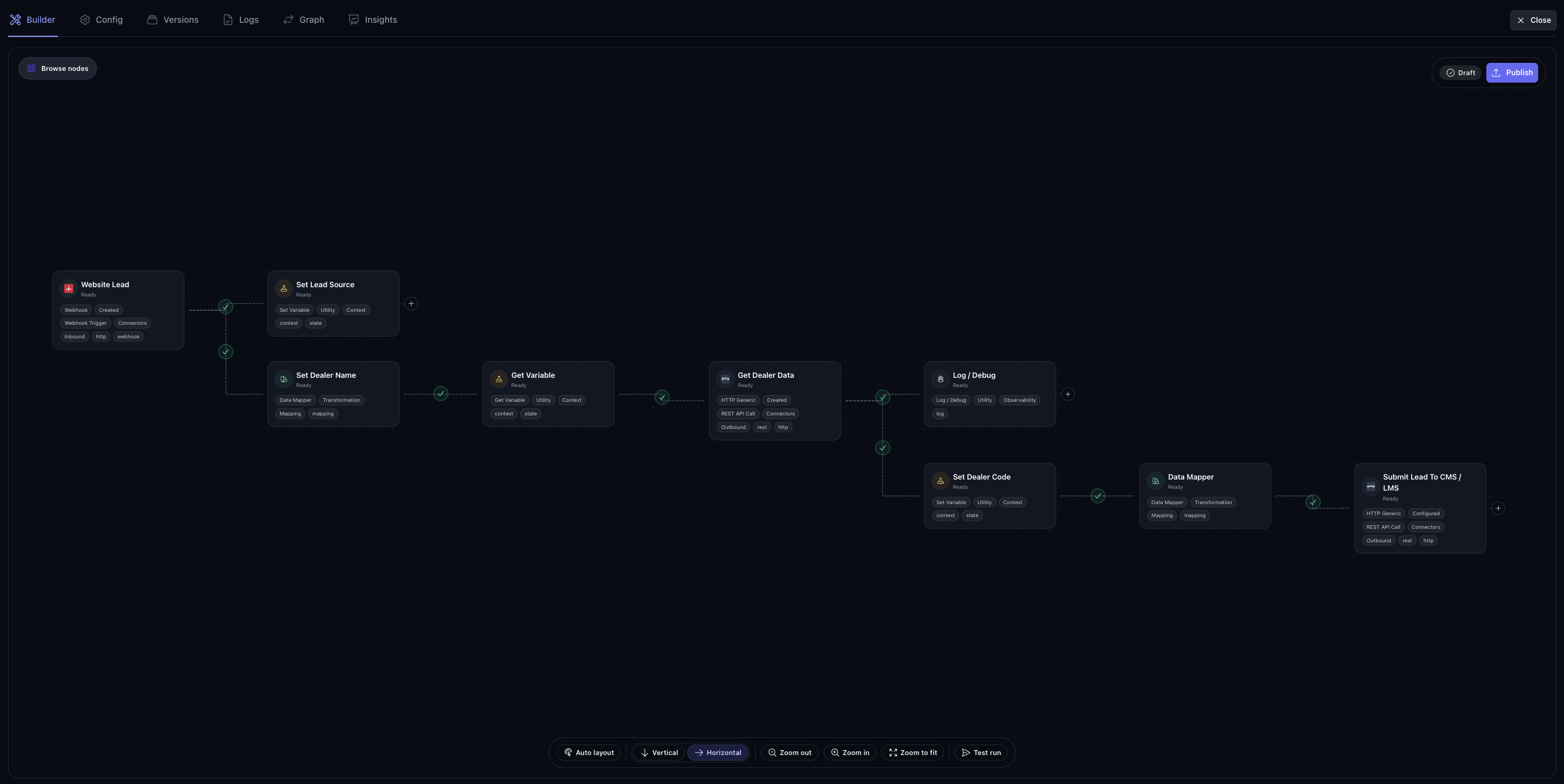
The integration pattern recreated in Dynomo: capture a website lead, retrieve dealer data, map the payload and submit it to the CMS or LMS.
View full-size image ↗ (opens in a new tab)The integration challenge
The systems existed. The connections needed work.
Honda had selected its lead management system. The challenge was connecting it to the channels generating enquiries and the dealer network responsible for following up.
Website forms and Meta lead ads arrived through separate paths. Manual handling slowed delivery and made it difficult to follow a lead from its source to the dealership.
WeFuse implemented an Azure-based, event-driven integration to automate that handover while retaining visibility across the process.
How the integration works
Capture. Map. Route. Deliver.
- 01
Capture leads at the source
With Dynomo, connect website forms and Meta (Facebook) Lead Ads through connectors. Capture incoming leads automatically and feed them into the workflow—without manual exports or separate handling for each channel.
- 02
Map every source to one canonical lead profile
Website forms and Meta Lead Ads use different field names and data structures. Map each source into one canonical lead profile—a shared structure for contact details, vehicle interest, location and campaign context. Routing and delivery then work with the same consistent profile, preserving context throughout the workflow. New sources map to that shared model without redefining the downstream process.
- 03
Resolve the dealer destination
Use location and routing logic to match the enquiry to a relevant dealership. Carry the customer’s context forward with the lead.
- 04
Deliver through the LMS
Send the mapped lead to Honda’s selected lead management system for distribution through the 50-dealer network. The LMS remains the operational destination.
- 05
Handle exceptions and retain visibility
The original Azure Service Bus architecture used asynchronous processing and dead-letter queues. Failed deliveries could be traced and investigated instead of disappearing into manual handovers.
The outcome
Better lead visibility. Higher conversion. Lower acquisition costs.
Connecting lead capture, dealer delivery and lifecycle updates gave Honda’s marketing team more than automated distribution. They could attribute leads to their source and receive real-time updates as each lead progressed—making it clearer which campaigns and audiences generated higher-quality enquiries.
That feedback helped the team build more precise audience segments, refine targeting and direct media spend towards the sources producing better leads. Dealer activity became actionable marketing insight, rather than a disconnected stage of the customer journey.
Increase in lead conversions
Better visibility into lead quality and progression supported campaign optimisation. Reported by Q3 2024 against pre-integration benchmarks.
Reduction in cost per lead
Improved attribution informed audience segmentation, targeting and media allocation, helping the brand acquire leads more efficiently.
Results from the original WeFuse project summary. These reflect the combined integration and marketing programme, not an isolated Dynomo performance benchmark.
Replicating the integration with Dynomo
From months of custom development to weeks of workflow configuration.
The opportunity is to reproduce this integration pattern using reusable connectors, data mappings and workflow steps. Teams can focus on the source contracts, dealer rules and destination requirements, with less infrastructure to build around them.
Configure the connections
Connect the lead sources and LMS through their available APIs. Reuse the connection configuration across workflows.
Model the process once
Separate incoming field mappings, dealer selection and outgoing payloads. Adapt the relevant step when a source or routing rule changes.
Weeks is the intended replication timeframe, not the measured duration of the 2024 rollout. Delivery depends on API access, mapping complexity, dealer rules and acceptance testing.
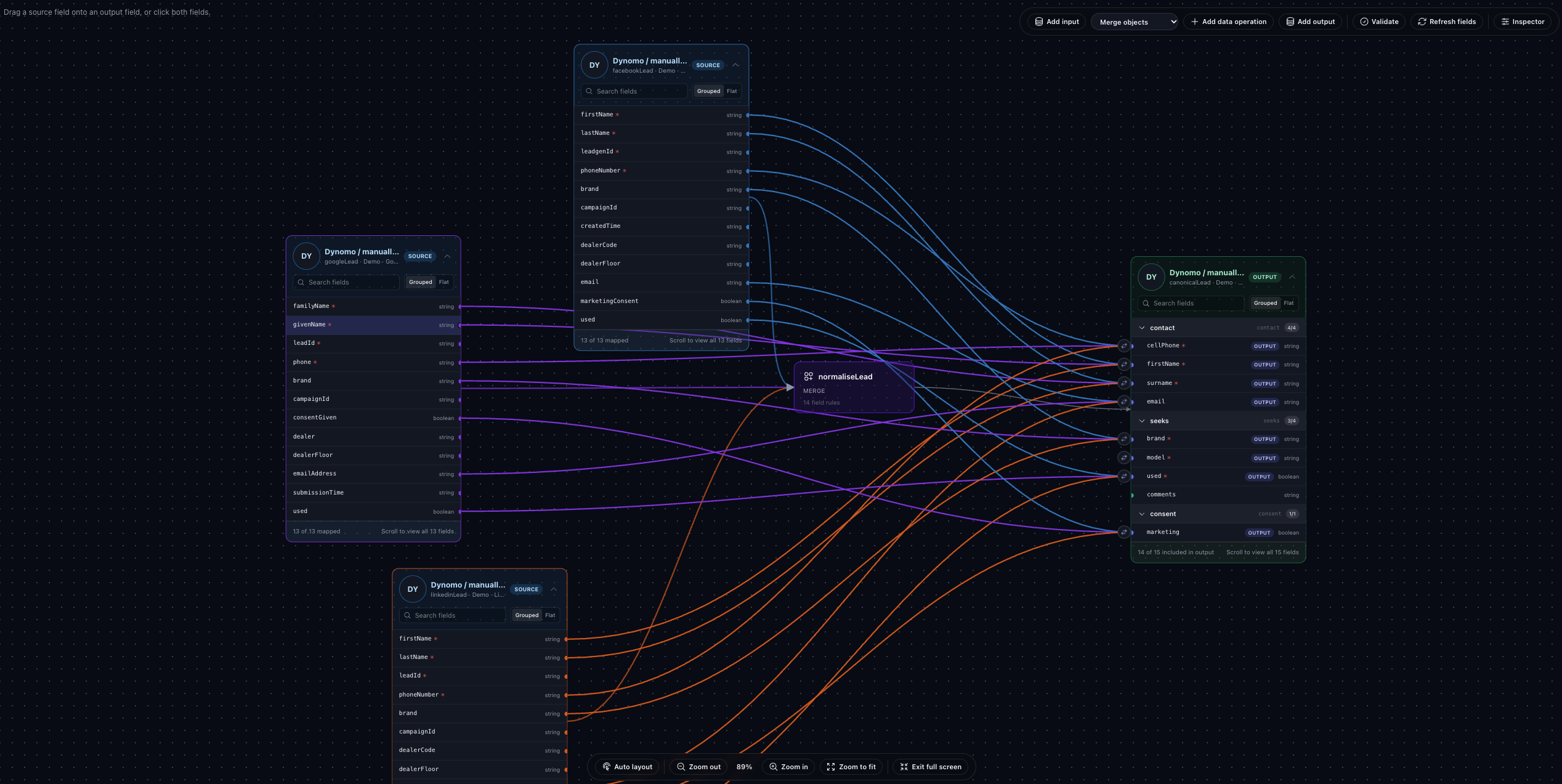
A mapping example in Dynomo: Google, Facebook and LinkedIn demo lead structures are normalised into a shared profile for contact details, vehicle interest and consent. Downstream workflows can work with one consistent structure, regardless of the source.
View full-size image ↗ (opens in a new tab)Connect the systems behind your customer journey.
Bring your lead sources, destination systems and routing requirements. We will map the integration with you.